
Alexa Emmons, a future dietitian’s impact on community health
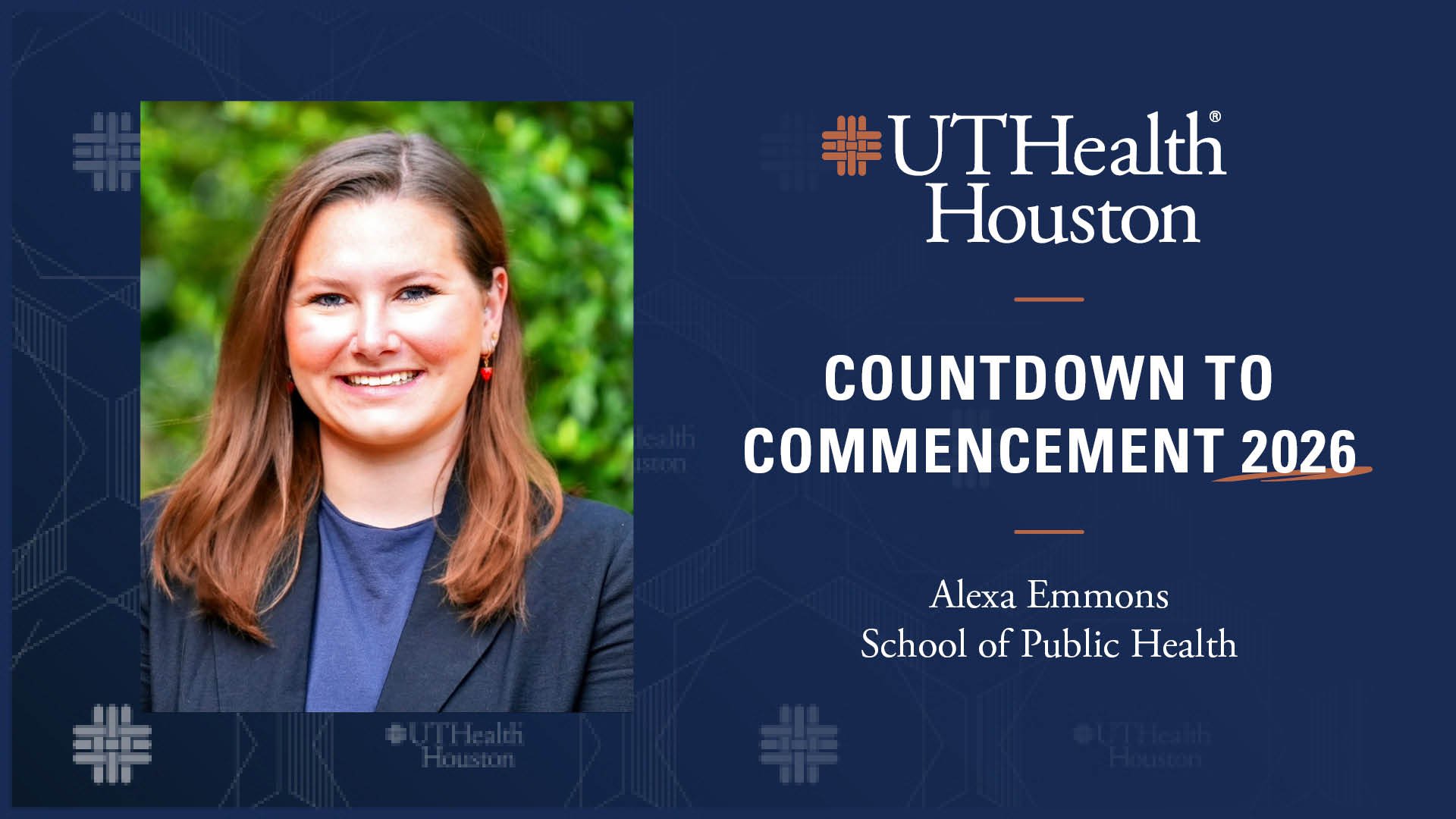
Students across UTHealth Houston are counting down to commencement, preparing to step into the next chapter of their careers. For Alexa Emmons, the milestone marks the culmination of a journey driven by a passion for nutrition, a commitment to underserved communities, and a desire to make a lasting impact beyond the four walls of a traditional clinic.
Finding a path through public health
Emmons’ path to graduate school was intentional, shaped by both her academic foundation in nutritional sciences at the University of Houston and a clear goal to pursue a dietetic internship alongside a master’s degree. Rather than following a traditional route, she deliberately sought out a program that would broaden her impact and extend her reach beyond the clinical setting.
“I wanted to get my master’s in public health, as opposed to the normal master’s in nutritional sciences, because I wanted to be able to help with public policy and help better the community in which I lived,” she said.
The opportunity to complete both her master’s degree and dietetic internship at the same institution made UTHealth Houston School of Public Health a natural choice.
“Having the opportunity to do both the master’s program and my dietetic internship was very important to me. I wanted to be able to go into a program that was nationally known and top ranked.”
A growing commitment to community
Originally from the San Antonio area, Emmons said her perspective on community health deepened through lived experiences and hands-on work.
“I would see different things in my community that I felt could be better,” she said. “I realized that all of that came through public health and wanting to better the community.”
That understanding only grew after arriving in Houston.
“That changed even more when I came to Houston and got to work with underprivileged communities and see how change can happen through public health initiatives.”
Her early involvement with food access programs and nutrition education helped shape her career direction.
“I got to work at the school’s food pantry and help build an initiative with them and do nutrition educational workshops. That put me in the community a lot, working with the Houston Food Bank.”
Turning knowledge into action
At the School of Public Health, Emmons translated her classroom learning into meaningful community programs. One of her most impactful projects involved developing a nutrition education curriculum for youth at Covenant House called “Cooking for Success.”
“I spent the summer developing a curriculum that was based on nutrition education and information for these students to be able to pass their food handler certification,” Emmons said.
The program combined education with practical outcomes. The end goal was to provide nutrition education and teach the importance of food safety.
Her work paid off. “Everyone passed,” she said with pride.
Beyond the certifications, the experience challenged assumptions and left a lasting impression.
“Some of these kids were some of the brightest people I’ve met in a long time and very hard workers. I think that these programs are so important. Thes kids and younger youth can thrive in life despite their current circumstances.”
Research and leadership in action
Emmons also expanded her impact through the Leadership Education in Adolescent Health Fellowship, where she focused on improving outcomes for young people through research and community-based initiatives.
Through her work with Brighter Bites, she contributed to efforts addressing childhood obesity in underserved communities.
“We took a produce prescription program where they got fresh fruits and vegetables delivered to them every week, as well as nutrition educational materials,” she said.
Now, she is helping evaluate the program’s effectiveness.
“I’m getting on the phone with them and getting the real nitty-gritty of what their experience is like and how this program is beneficial. I’m asking questions like ‘How can we make this more known? How can we continue to build this out so that we can help our community?’”
Looking ahead
With graduation on the horizon, Emmons is focused on the next step: becoming a registered dietitian and continuing her work in both clinical and community settings.
“My plan is to take my board exam to become a registered dietitian,” she said. “And then I hope to work in a pediatric hospital setting.”
But her goals extend beyond a traditional career path.
“I hope to be involved in some way, in some capacity, in research or doing a nonprofit. I want to continue to have an impact within my community outside of just doing my basic clinical work.”
Advice for future students
Reflecting on her journey, Emmons emphasized the importance of self-advocacy and mentorship.
“One of the biggest things is to not be afraid to ask for what you want,” she said. “My grandma always says, ‘You can’t eat with your mouth closed.’”
She credits much of her success to the support she found along the way.
“Leaning into your mentorship and your faculty. Having people that you can come to and be completely transparent is what’s going to help get through day to day.”
Finding balance along the way
Despite the demands of graduate school, she made time for personal interests that help her recharge.
“I’m really into reading, and I recently learned how to crochet,” Emmons said. “I’ve been trying to do fun hobbies like that or just going out on the weekend and getting to hang out with friends.”
As she prepares to graduate, Emmons’ story reflects not only academic achievement, but a deep commitment to improving lives through nutrition, education, and community-driven care.