
Spotlight: Yesmeena Shmaitelly, Learning Medicine Beyond the Clinic Through Food Is Medicine Research
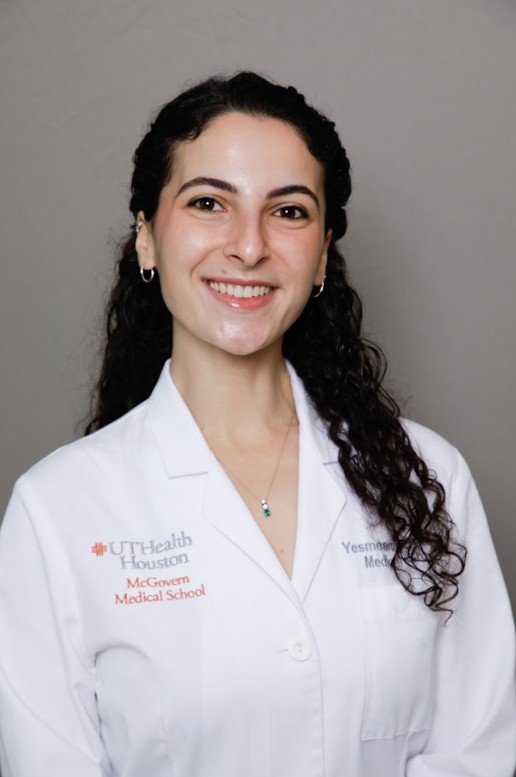
Since May 2025, second-year student at McGovern Medical School at UTHealth Houston, Yesmeena Shmaitelly, has played a pivotal role in advancing the Harris Health Food is Medicine (FIM) study, a multi-phased project providing fresh produce and nutrition education to at-risk pregnant mothers in the Greater Houston region.
When asked about what inspired her professional journey leading her to McGovern Medical School and public health research, she adds that she can’t point to one singular moment that led her to pursue medicine. Instead, she describes her motivation as a series of events with a touch of serendipity which transformed quietly and steadily into clarity. One of the most formative experiences came from witnessing her father’s journey through end-stage renal disease and ultimately his kidney transplant. That experience, she explains, shaped her understanding of illness, healing, and the human connections at the center of care.
When Shmaitelly arrived at McGovern Medical School, she had never heard of the Center for Healthy Communities (CHeC). She knew no one at the School of Public Health, nor did she have a clear sense of how to get involved in public health research. Her introduction came through Rupa Mahadevan, MD, assistant professor of Community and General Pediatrics at McGovern Medical School and culinary medicine instructor with the School of Public Health’s Nourish Program, a nutrition education program managed by the Michael & Susan Dell Center for Healthy Living.
She began sending cold e-mails across the school searching for any opportunity to collaborate. In that process, she stumbled upon FIM research.
“I came in not knowing anything about Food is Medicine. The more I learned, the more I loved it.”
Her early reading led her to reach out directly to the authors of several papers. That trail eventually connected her to CHeC Director, Shreela Sharma, PhD, RDN, LD, and CHeC Graduate Research Assistant and doctoral student in the Department of Health Promotion & Behavior Sciences, Lorena Macias-Navarro, MSc.
This contact allowed Shmaitelly to formally join CHeC as part of the McGovern Summer Research Program, which invites undergraduates and first-year medical students to conduct research across UTHealth Houston.
Under the Center team’s guidance, she joined a multi-phase Harris Health study examining how fresh produce, meal kits, and tailored nutrition support improve maternal health outcomes. Phase 2 (2024–2025) enrolls 200 patients receiving either home-delivered produce or produce plus Flora, a nutrition chatbot, while Phase 3 (launched December 2025) enrolls 400 patients at risk for gestational diabetes to receive bi-weekly meal kits with CHW support followed by postpartum produce deliveries, or bi-weekly gift cards.
Her work centered around two major aims:
AIM 1: Abstract development + qualitative interviews
She partnered closely with Macias-Navarro to draft an abstract and conduct qualitative interviews with phase 2 participants about their experiences using the Flora chatbot.
AIM 2: Designing a culturally diverse recipe book
Drawing on her digital design skills, Shmaitelly helped create a cookbook featuring recipes and produce guidance tailored for women at risk for gestational diabetes for phase 3.
The project gave her space to blend creativity, culture, and evidence-based nutrition. “Cooking is my love language. I’m Middle Eastern; we show affection through food,” Shmaitelly added.
At the conclusion of the summer program, Shmaitelly delivered a flash talk to her peers in the Summer Research Program, as well as CHeC faculty and staff. In the fall, she submitted an abstract and poster to the SRP Research Forum, and was nominated by Sharma for the C. Frank Weber Prize for Student Research.
As she transitioned into the fall semester, Shmaitelly initially worried about balancing medical school responsibilities with new research demands. But instead of stress, she found energy and joy in the work.
She began to see public health research not as an academic exercise, but as a form of service and practice.
“I don’t think medical students are doing enough public health research,” she explained. “By helping moms put food on the table, the work we do at the CHeC makes an impact in real time And I think medical students would love being part of that.”
She also drew unexpected parallels between clinical practice and qualitative research.
“During a clinic visit, physicians build rapport and ask strategic questions to understand their patients. Qualitative research mirrors that: the same listening, curiosity, and respect for people’s stories.”
Through iterative feedback, writing guidance, presentation coaching, and countless conversations, Shmaitelly developed skills she believes will shape her entire career: writing, communication, collaboration, and human-centered inquiry.
Today, Shmaitelly continues to support the study while navigating the demands of her second year in medical school. The experience deepened her commitment to health advancement and to understanding how food, care, and community can shape health long before a patient enters a clinic.